
Quickly Launching a Parent-Child Game Website Using Windsurf
Together with my son, I developed an online Tic-Tac-Toe game using Windsurf, quickly implementing it to make parent-child interaction more convenient. During the process, we also built a multilingual parent-child game platform, experiencing the potential of AI in development. This project not only enhanced parent-child communication but also showed me the warmth of technology and the power of rapid development.
Recently, my son and I embarked on an interesting and unexpected development journey, giving me a fresh perspective on technology and parent-child interaction. It all started simply: one day after school, my son excitedly pulled me to play a small game called "Tic-Tac-Toe" on paper.
Speaking of Tic-Tac-Toe, I am more familiar with Gomoku. This was my first time encountering such a simple yet strategic small board game. My son enthusiastically explained the rules, and we drew grids on paper to play. The game was simple but fun, yet having to redraw the board each time was a bit cumbersome. Then my son suddenly said, "Dad, you can code, right? Can we make a version that can be played on a phone?"

His words sparked inspiration. That night, while my son was asleep, I decided to try using Windsurf to quickly implement an online version of Tic-Tac-Toe.
Windsurf is a lightweight tool I use for development, known for its simplicity and efficiency, ideal for quickly realizing small projects. Using it, I quickly completed the front-end and back-end logic of Tic-Tac-Toe and hosted the game on my personal blog. This way, there was no need to draw boards on paper, and the game could be played anytime on tablets, phones, or computers, making parent-child interaction more natural and relaxed.
But it didn’t end there. Lying in bed that night, I wondered if such small parent-child interactive games could become a larger platform. "If we had an online platform supporting multiple languages, it could not only enhance parent-child interaction but also let more families experience this joy—wouldn’t that be more meaningful?"
So, I continued putting this idea into practice. From conception to launch, it took just a few hours to create a multilingual parent-child game website. The platform is simple yet complete, containing four games and supporting nine languages, a small but interesting result of an "AI productivity revolution."
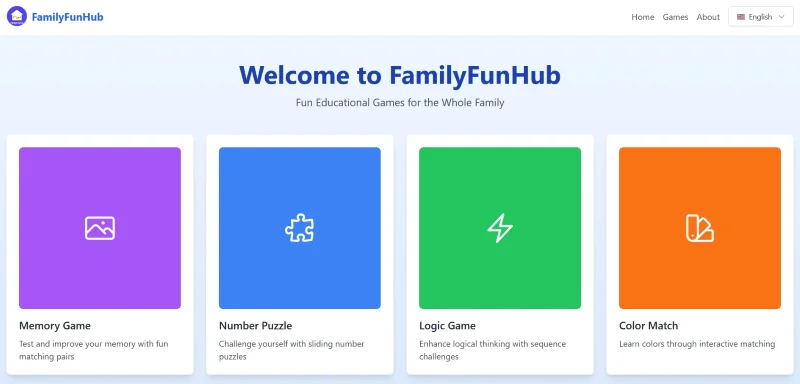
What pleasantly surprised me was that domain selection and development ideas were partly inspired by ChatGPT suggestions familyfunhub.com. It demonstrated the great potential of AI in development. Typically, building such a platform could take days or weeks, but with AI tools and Windsurf’s efficiency, I achieved the leap from concept to product in just 2-3 hours.
Of course, while the site’s functionality is simple and the interface basic, its significance fills me with a sense of achievement:
- Enhanced parent-child interaction: From traditional paper games to online versions playable anytime, this is not just a tech application but an improvement in parent-child communication.
- Technical extensibility: Rapid development using Windsurf allowed me to appreciate the advantages of simple tools in solving practical problems.
- Exploration of multilingual support: Supporting multiple languages helped me connect with users. This multicultural design opens up global possibilities.
Finally, some personal reflections:
- The warmth of technology: Coding is not just about writing programs; it can also bridge family relationships. A simple Tic-Tac-Toe game deepened my interaction with my son.
- The power of rapid development: Combining modern tools and AI can turn ideas into reality at unprecedented speed. Efficient tools are keys to achieving dreams.
- Educational possibilities: I involved my son in basic design discussions, sparking his interest in coding. Perhaps this is his starting point.
Now, the platform is live, and my son and his classmates enjoy it immensely. I feel fulfilled, gaining technical insights and precious family moments. To all parents and developers: never underestimate the power of a small idea—it may change your life.
In the future, I plan to improve the platform further, adding more engaging parent-child games and features for more families to benefit. Perhaps this marks a new beginning in my development journey.